Analytical Techniques for Oligonucleotide Impurity Analysis and Separation

  The rapid advancement of oligonucleotide therapeutics has introduced new analytical challenges for pharmaceutical scientists. These nucleic acid–based drugs, including antisense oligonucleotides and siRNA, often contain closely related impurity species that differ from the target molecule by only a single nucleotide or minor chemical modification. Accurate identification and quantification of these impurities are essential to ensure product quality, safety, and regulatory compliance. However, traditional analytical approaches used for small-molecule drugs are often insufficient for these larger, highly charged biomolecules. As a result, specialized analytical techniques are required. Chromatographic separation methods, combined with advanced detection technologies, play a central role in oligonucleotide impurity analysis.

Analytical Challenges in Oligonucleotide Impurity Profiling

Oligonucleotides present several unique analytical challenges:
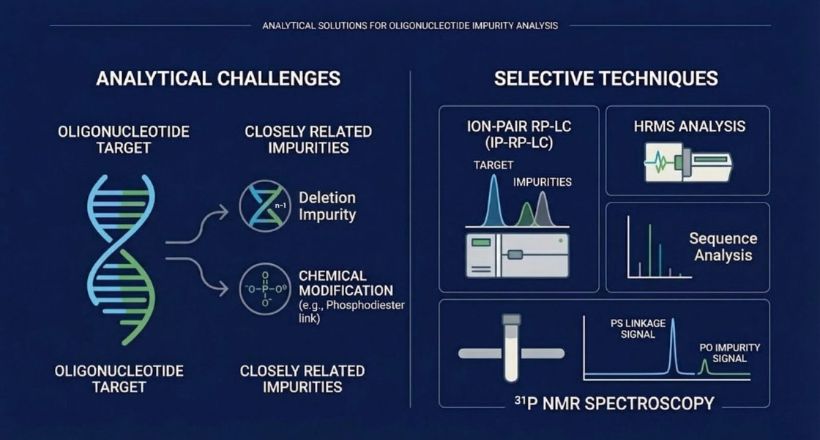
  • High structural similarity: Impurities such as n–1 or n–x truncations, deletion sequences, and mismatch variants differ from the target by only a single nucleotide, making separation difficult.
  • Synthesis-related impurities: Solid-phase synthesis can introduce failure sequences, depurination products, and incomplete deprotection species.
  • Chemical modifications: Therapeutic oligonucleotides often include modifications such as phosphorothioate linkages or 2′-O-methyl groups, increasing molecular heterogeneity.
  • Charge and size effects: The high negative charge density and relatively large molecular size influence chromatographic behavior through counterion interactions and potential secondary structures.
Because of these complexities, high-resolution and highly selective analytical techniques are required for effective impurity profiling.

Ion-Pair Reversed-Phase Liquid Chromatography (IP-RP-LC)

Ion-pair reversed-phase liquid chromatography (IP-RP-LC) is one of the most widely used techniques for oligonucleotide analysis. In this method, ion-pairing reagents interact with the negatively charged phosphate backbone of oligonucleotides, enabling their retention on hydrophobic stationary phases. Separation is driven by a combination of ion-pair interactions and apparent hydrophobicity differences. Common ion-pairing systems include:
  • Triethylammonium acetate (TEAA)
  • Hexafluoroisopropanol (HFIP) with triethylamine (TEA), especially for LC–MS applications
IP-RP-LC is particularly effective for resolving truncated sequences and closely related impurities, making it a key tool in impurity profiling during drug development.

Ion-Exchange Chromatography

Ion-exchange chromatography separates oligonucleotides based on their charge interactions with the stationary phase. Since oligonucleotides carry multiple negative charges along their backbone, this technique is well suited for separating sequence variants, truncated species, and impurities differing in charge density. Separation is influenced by:
  • Charge density
  • Sequence length
  • Base composition
Ion-exchange chromatography is often used as a complementary technique to reversed-phase methods. However, it may require desalting prior to mass spectrometry analysis, which can add complexity to workflows.

High-Resolution Mass Spectrometry (HRMS)

High-resolution mass spectrometry (HRMS), when coupled with liquid chromatography (LC–HRMS), is a powerful tool for oligonucleotide characterization. This technique enables:
  • Accurate molecular weight determination 
  • Identification of sequence variants 
  • Detection and localization of chemical modifications 
Because oligonucleotides generate multiple charge states, data analysis requires charge-state deconvolution. High resolving power is particularly important for analyzing larger oligonucleotide molecules. LC–HRMS plays a critical role in confirming impurity identities and supporting analytical method development.

Nuclear Magnetic Resonance (NMR) Spectroscopy

Nuclear Magnetic Resonance (NMR) spectroscopy is a valuable complementary technique for the structural characterization of oligonucleotides and their impurities. Unlike mass spectrometric methods, NMR provides direct molecular-level structural information, making it particularly useful for confirming backbone chemistry and chemical modifications.

Detection of Phosphodiester (PO) Impurities

In phosphorothioate (PS)-modified oligonucleotides, phosphodiester (PO) impurities can arise due to incomplete sulfurization during synthesis. These impurities are critical to monitor because they can affect biological stability and overall drug performance. ³¹P NMR is especially well suited for detecting PO impurities because phosphorus atoms in different chemical environments produce distinct signals. Using ³¹P NMR, analysts can:
  • Differentiate PO and PS linkages based on their chemical shifts 
  • Quantify PO impurity levels through signal integration 
  • Observe PS stereochemistry (Rp/Sp diastereomers), which appear as characteristic split peaks 
  • Assess overall backbone composition without prior separation 
Typically, PO linkages generate signals at chemical shifts distinct from PS linkages, enabling clear identification even in complex mixtures. Beyond PO impurity detection, NMR can also be used to:
  • Confirm phosphorothioate linkage integrity 
  • Identify sugar and base modifications 
  • Evaluate conformational and structural features 

Importance of High-Purity Analytical Standards

Reliable impurity analysis depends on the availability of well-characterized analytical standards. These standards are essential for:
  • Confirming impurity identity 
  • Validating analytical methods 
  • Enabling accurate quantification 
They are especially important when analyzing closely related oligonucleotide variants, where precise identification is critical. High-quality standards also support compliance with regulatory guidelines such as ICH Q2 and Q6B.

Advancing Analytical Solutions for Oligonucleotide Drugs

As nucleic acid therapeutics continue to evolve, the demand for advanced analytical techniques capable of resolving complex impurity profiles will grow. Robust and orthogonal analytical approaches combining chromatography, mass spectrometry, and NMR are increasingly required to ensure comprehensive characterization and to meet stringent regulatory expectations. At Daicel Chiral Technologies India, we support pharmaceutical research by providing expertise in advanced analytical solutions and high-quality analytical standards for oligonucleotide drugs.

Oligonucleotide Drug Impurities: Generic Industry Implications and the Regulatory Expectations


From Chemistry to Consequence: What the Industry Must Now Solve

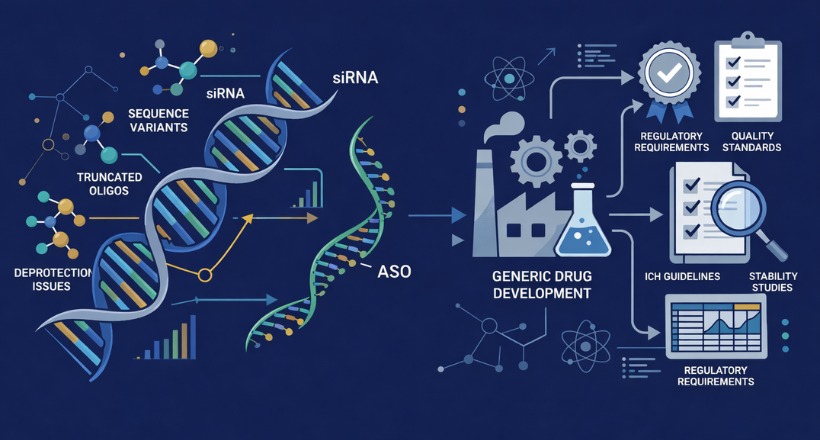
The oligonucleotide drug market is no longer a niche. Over 20 products are approved globally as of early 2026, with a pipeline that spans hundreds of candidates across phases. The first generic oligonucleotide applications have been filed. Regulatory agencies have issued new — and more specific — guidance on impurity characterisation and control. Contract manufacturing organisations, analytical service providers, and reference standard suppliers are all being asked to develop capabilities that did not exist as commercial offerings five years ago. This blog examines what those industry demands look like in practice: which analytical methods are now standard or emerging, what the 2026 regulatory environment expects from manufacturers, and where Daicel — through both its Analytical Services division and its Pharma Standards business — fits into this increasingly complex picture.

The Industry Pressure Points: Where Quality Science Gets Tested

Three structural forces are shaping how the oligonucleotide industry approaches impurity analysis right now, and each creates a distinct kind of demand on analytical infrastructure.

Scale-Up and Manufacturing Consistency

The majority of approved oligonucleotide drugs were developed and initially manufactured at relatively small scale, with analytical characterisation carried out by specialised academic or early-phase contract labs. As products mature commercially and demand grows, manufacturing must scale — and scale introduces new process variables. Step efficiency, column loading on preparative chromatography, reagent lot-to-lot variability, and lyophilisation parameters can all shift the impurity profile in ways that require systematic re-characterisation. Regulatory agencies expect manufacturers to demonstrate that the impurity profile is consistent across manufacturing scales and that any changes are evaluated for their impact on drug substance quality.

Generic Oligonucleotides: The Sameness Problem

The loss of market exclusivity for nusinersen (Spinraza) has opened the first serious chapter of oligonucleotide generics development. Demonstrating that a generic oligonucleotide is the same as its reference-listed drug is not a straightforward bioequivalence exercise. For a fully phosphorothioated 20-mer ASO with 19 PS linkages, the theoretical diastereomeric space contains more than 500,000 stereoisomeric species. Demonstrating that a generic product has the same diastereomeric composition as the reference product — across the entire distribution, not just at a summary level — requires analytical capabilities that push current technology to its practical limits. The FDA's Office of Generic Drugs has been explicit about this expectation. Its FY2025 generic drug science initiative flagged diastereomeric characterisation as a key unresolved challenge and endorsed a multi-method approach — multiple LC strategies, MS/MS fragmentation sequencing, and ³¹P NMR — as the recommended framework for sameness assessment. This is now the expected standard for generic oligonucleotide submissions, and it is driving rapid investment in the relevant analytical capabilities across the industry.

Stereopure Oligonucleotides: A New Quality Paradigm

Simultaneously, the frontiers of innovator oligonucleotide development are moving toward stereopure synthesis — where each PS linkage is synthesised with a defined, single Rp or Sp configuration, using chiral auxiliary or stereoselective coupling chemistry. Ionis Pharmaceuticals pioneered this approach, and clinical data have demonstrated that specific diastereomeric configurations confer superior potency or tolerability depending on sequence context and target tissue. For stereopure drugs, the analytical requirement is fundamentally different from characterising a diastereomeric mixture. The question is no longer 'what is the distribution of stereoisomers?' but 'is the stereochemistry at each defined position correct?' This is a higher-resolution chiral analysis challenge that requires methods capable of confirming positional stereochemical fidelity — and it represents a growing area of demand for specialised analytical services.

The Regulatory Landscape in 2026

EMA Draft Guideline on Oligonucleotide Development and Manufacture

The EMA issued its first guideline dedicated specifically to oligonucleotide drug development and manufacture in July 2024. The consultation period closed in January 2025; finalisation is expected during 2026. The guideline establishes that impurities above 1.0% must be identified and those above 1.5% must be qualified through appropriate safety data. It requires multiple orthogonal purity methods — sole reliance on a single technique is explicitly insufficient. For PS-containing oligonucleotides, diastereomeric characterisation is mandatory. The guideline also clarifies that oligonucleotides fall outside the scope of ICH Q3A, meaning manufacturers cannot apply small-molecule impurity frameworks and must develop oligonucleotide-specific qualification strategies.

FDA Nonclinical Safety Guidance and Generic Drug Expectations

FDA CDER's 2024 draft guidance classifies oligonucleotide impurities as sequence-related species (for which manufacturing process control is the primary management tool) and process-related impurities (governed by ICH Q3C, Q3D, and applicable environmental standards). The FDA's Office of Generic Drugs has simultaneously elevated its expectations for generic oligonucleotide applications — particularly around diastereomeric sameness — requiring a multi-method analytical package that reflects the current state of the art.
Guideline / Framework Key Threshold / Scope Impurity-Specific Requirement
EMA Draft Guideline (2024 → final 2026) Identify ≥1.0%; Qualify ≥1.5% Orthogonal methods required; PS diastereomers must be characterised
FDA Nonclinical Safety Guidance (Draft 2024) Sequence-related vs. PRI classified separately Process control primary; ICH Q3C/Q3D govern PRIs
FDA OGD — Generic Oligonucleotides (FY2025) Diastereomeric sameness required for PS-ONs Multi-method LC + MS/MS + NMR strategy mandated
ICH Q3D — Elemental Impurities PDE limits for injectables ICP-MS required for metal catalysts
ICH Q3C — Residual Solvents Class 1/2/3 limits Applies to ACN, DCM, pyridine from SPPS

Where Daicel Fits: Analytical Services and Pharma Standards

Daicel Chiral Technologies India expertise in the oligonucleotide space maps onto two concrete commercial capabilities: Daicel Analytical Services, which addresses the method development and characterisation needs of drug developers, and Daicel Pharma Standards, which addresses the equally critical — and chronically underserved — demand for well-characterised and certified oligonucleotide impurity standards.

The Road Ahead

Several near-term developments will shape the oligonucleotide impurity landscape through 2026 and beyond. Finalisation of the EMA guideline will bring greater regulatory certainty but also higher analytical expectations — particularly on orthogonal method validation and stability-indicating method qualification. The first generic oligonucleotide approvals will establish precedents for diastereomeric sameness assessment that the entire industry will need to follow. And the continued expansion of stereopure oligonucleotide clinical programmes will pull demand for high-resolution chiral characterisation out of academic and early-phase settings and into commercial QC. Platform-based impurity qualification strategies — where the structural similarity of oligonucleotide sequence variants to the parent molecule justifies streamlined nonclinical qualification — are gaining regulatory acceptance, reducing the burden of individualised safety studies while maintaining scientific rigour. The modality has earned its place in the therapeutic mainstream. The analytical science needed to support it is catching up fast — and the organisations that build genuine depth in oligonucleotide impurity characterisation, particularly in its stereochemical dimensions, are well-positioned for the decade ahead.

The Next Wave of Metabolic Health: Navigating Phase-3 GLP-1 Pipelines and the Analytical Challenge

  The pharmaceutical landscape is currently dominated by a "gold rush" in metabolic health. As of early 2026, the global success of existing treatments has paved the way for a second generation of Glucagon-Like Peptide-1 (GLP-1) receptor agonists currently in Phase-3 trials. For manufacturers and quality control labs, this surge brings a complex set of analytical challenges: navigating the rigorous impurity standards required for these increasingly sophisticated (bio)synthetic molecules.

The Phase-3 Pipeline: Beyond Simple GLP-1 Agonism

Current Phase-3 candidates are moving toward "poly-agonism"—targeting multiple receptors simultaneously to maximize weight loss and glycemic control.
  • Retatrutide: A triple agonist targeting GIP, GLP-1, and glucagon receptors, built on a GIP peptide backbone with a C20 fatty diacid conjugation for extended half-life. Phase-3 TRIUMPH trials are well advanced, with TRIUMPH-4 topline results already reported in late 2025 and seven additional readouts expected through 2026. Its 39-amino acid sequence requires hyper-specific standards to monitor for truncated sequences and D-amino acid isomers.
  • Orforglipron: A significant shift as a non-peptide, small-molecule oral GLP-1. Unlike traditional peptides, its impurity profile will follow standard ICH Q3A/B guidelines, focusing on process catalysts and degradation rather than peptide-related substances.
  • CagriSema: A fixed-dose combination of semaglutide and the amylin analogue cagrilintide. Analyzing impurities in a co-formulated product requires advanced orthogonal methods, such as 2D-LC or HILIC-MS, to distinguish between degradation products of two different peptides in a single vial.
  • Survodutide: A dual GLP-1 and glucagon receptor agonist undergoing Phase-3 SYNCHRONIZE trials for obesity management in adults with and without type 2 diabetes. A separate Phase-3 program, LIVERAGE, evaluates survodutide for MASH and hepatic fibrosis. Both programs demand high-purity standards capable of withstanding rigorous stability testing across distinct patient populations.

The Impurity Mandate: Why 0.1% Matters

For any laboratory supporting GLP-1 development, the regulatory bar is exceptionally high. Because many GLP-1s are synthetic or hybrid-recombinant peptides, they sit in a unique regulatory space.
  1. The Sameness Criteria: For generic GLP-1s to be approved via the ANDA pathway, the impurity profile must be "the same as or better than" the Reference Listed Drug (RLD).
  2. New Impurity Thresholds: FDA guidance for synthetic peptides dictates that any new impurity (not found in the RLD) between 0.10% and 0.5% must undergo rigorous in vitro immunogenicity risk assessment.
  3. The 0.5% Hard Cap: New peptide-related impurities exceeding 0.5% are generally not acceptable for generic approval without extensive clinical data.

Technical Corner: MS Identification of GLP-1 Impurities

The challenge in GLP-1 impurity analysis is not simply detecting what is there — it is knowing which tool to reach for first, and when the first tool is no longer enough. No single analytical platform covers the full impurity landscape of a synthetic or semi-synthetic peptide. UHPLC-HRMS serves as the primary engine, but it has a hard boundary: it is blind to stereochemistry. Understanding where that boundary sits — and what sits beyond it — is what separates a reactive QC function from one that anticipates regulatory scrutiny.

1. UHPLC-HRMS: The Primary Engine

UHPLC coupled to high-resolution mass spectrometry (Orbitrap or Q-TOF platforms) offers sub-5 ppm mass accuracy, which translates directly into the ability to assign molecular formulas to trace-level degradants without a reference standard in hand. For long-chain peptides like retatrutide (39 amino acids) or the dual-component CagriSema, this matters because the degradant space is wide: oxidation, deamidation, truncation, and acetylation can each produce multiple co-existing species at levels approaching the 0.10% immunogenicity threshold. The HRMS software workflow generates b- and y-ion series from MS/MS fragmentation, enabling unambiguous localisation of modifications — for instance, confirming whether an oxidation event sits on Met or on the Trp residue of a specific sequence position. For impurities with no database match, de novo sequencing tools reconstruct the peptide sequence purely from fragment ion patterns, removing dependence on a pre-built spectral library. This is particularly valuable during early Phase-3 stability studies, when the degradant map is still being drawn.

2. Where CID Fragmentation Reaches Its Limit: Isomeric Residues

Standard collision-induced dissociation (CID) cannot distinguish between residue pairs that share identical nominal masses: Leucine/Isoleucine (Leu/Ile) and Tryptophan/Iso-Tryptophan (Trp/Iso-Trp) both produce overlapping fragment ion series under CID conditions. For molecules whose potency or immunogenicity profile is sensitive to the precise residue at a given position, this ambiguity is analytically unacceptable. Advanced electron-based dissociation modes resolve this. Electron Capture Dissociation (ECD) and Electron Transfer Dissociation (ETD) generate c- and z-type fragment ions that preserve labile side-chain bonds, producing characteristic fragmentation patterns that differentiate Leu from Ile at specific sequence positions. ETD is also the method of choice for disulfide bond characterisation — increasingly relevant as next-generation GLP-1 conjugates incorporate cysteine-bridged fatty acid linkers designed for albumin binding and half-life extension. The hard limit, however, is D-amino acid epimers. Racemisation at chiral centres — a documented risk during extended solid-phase peptide synthesis (SPPS) cycles or under accelerated stability conditions — produces diastereomers with an exact mass difference of 0.000 Da.

3. 2D-LC-HRMS: Resolving Co-eluting Impurities in Complex Matrices

Co-formulated products like CagriSema present an additional complication: degradation products from two structurally distinct peptides — semaglutide and cagrilintide — can co-elute under standard reversed-phase conditions. Single-dimension LC, even with HRMS detection, cannot assign a peak unambiguously when two species share a retention window. Two-dimensional LC resolves this through orthogonal separation chemistry. RP-RP 2D-LC exploits pH differences between dimensions to resolve peptides with similar hydrophobicity under matching stationary phase chemistry. RP-HILIC 2D-LC takes a more contrasting approach: the hydrophilic interaction dimension retains highly polar degradants and glycosylated species that reverse-phase would elute near the solvent front, providing clean separation of the most problematic co-eluters. Both modes are routinely coupled to HRMS for real-time identification of re-separated fractions, making the full workflow genuinely quantitative rather than merely qualitative

4. Common m/z Shifts: A Reference Guide for GLP-1 Analogue Characterisation

The table below captures the most frequently encountered mass shifts during GLP-1 analogue synthesis and stability testing. Each entry includes the analytical challenge specific to GLP-1 molecules — because the difficulty is rarely in knowing the shift exists, but in resolving it from the noise of a structurally complex peptide matrix.
Impurity Type Chemical Cause Mass Shift (Da) Analytical Challenge
Deamidation Asn/Gln → Asp/Glu conversion +0.984 Tiny shift; demands >100,000 resolving power. Common at Asn8 in semaglutide.
Oxidation O addition to Trp or Met residues +15.995 Generates multiple sulfoxide peaks; site localisation requires MS/MS.
Acetylation N-terminal capping or Lys side-chain (SPPS artefact) +42.011 Common process impurity in SPPS; overlaps trimethylation (+42.047) without HRMS.
Sodium Adduct Interaction with glassware or Na-containing reagents +22.990 Suppresses [M+H]+ signal; complicates quantitation without charge-state deconvolution.
Truncation Loss of N- or C-terminal amino acids during SPPS Variable (large) Critical for potency; de novo sequencing needed for long truncations in 39-aa peptides like retatrutide.
Diastereomers (D-amino acids) Racemisation at chiral centres during SPPS or storage 0.000 (invisible to MS) MS-invisible. Requires chiral chromatography (e.g., Daicel CHIRALPAK® columns) for detection and quantitation.
His-Cyclic (Hydantoin) N-terminal His cyclisation to hydantoin derivative (degradation) −18.011 Significantly reduces biological activity. Relevant to all His1-containing GLP-1 analogues incl. semaglutide and liraglutide.
Note on the His-Cyclic Variant: The hydantoin derivative arises specifically in GLP-1 analogues with a free N-terminal histidine (His1) — which includes semaglutide and liraglutide. The −18.011 Da loss is detectable by HRMS but requires a certified impurity standard for confident quantitation, since the shift overlaps with other dehydration artefacts in a complex degradant mixture. Daicel supplies certified standards for the major GLP-1 analogue impurities, including His-cyclic variants, to support both method development and regulatory filing.

Conclusion: Quality as the Competitive Edge

As the market for GLP-1s expands into Alzheimer’s disease, cardiovascular health, and MASH — each new indication adds its own analytical layer. CNS-targeted formulations will require blood-brain barrier penetration profiling, while cardiac endpoints demand longer stability windows. In every case, the speed-to-market for new therapies and generics will depend on analytical precision. Utilizing high-quality impurity standards for the upcoming generation of agonists is no longer just a compliance step, it is a strategic necessity to ensure patient safety and regulatory success. Reflecting its rich experience in the field, Daicel Chiral Technologies India supports GLP-1 peptide development programs by providing comprehensive analytical services along with certified impurity standards, enabling robust characterization, method development, and regulatory-ready quality control throughout the drug development lifecycle. Partner with Daicel to accelerate your GLP-1 programs. Disclaimer: All product and company names are trademarks™ or registered® trademarks of their respective holders. Use of them does not imply any affiliation with or endorsement by them. The chemical names and structures discussed are provided for analytical research and development purposes only to support the identification of impurities in accordance with global regulatory standards. Any discussion of Phase-3 candidates is based on publicly available clinical trial data and does not constitute medical or investment advice.

NDSRIs (Nitrosamine Drug Substance–Related Impurities): Regulatory Risk, Analytical Challenges, and Control Strategies

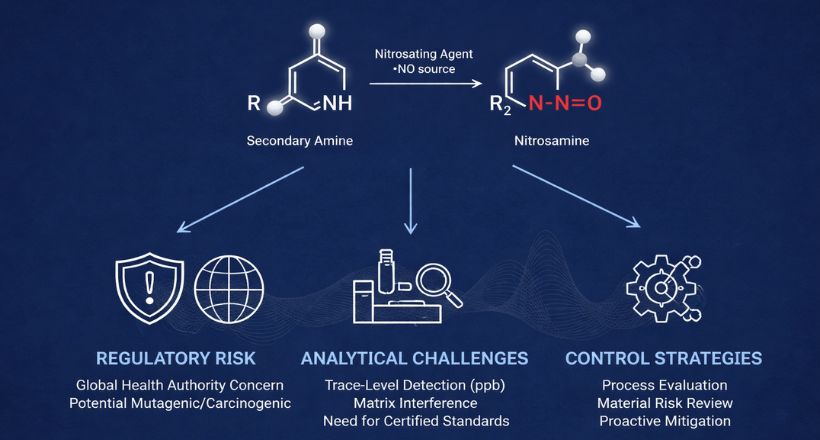
  Nitrosamine Drug Substance–Related Impurities (NDSRIs) have emerged as a critical concern for pharmaceutical manufacturers and regulators worldwide. Unlike simple nitrosamines, NDSRIs are structurally related to the active pharmaceutical ingredient (API) and may form during synthesis, processing, or storage. Because many nitrosamines are classified as probable human carcinogens, regulatory agencies require robust risk assessment, sensitive analytical detection, and effective control strategies. As regulatory scrutiny increases, pharmaceutical companies must adopt science-based approaches to identify, quantify, and mitigate NDSRIs to ensure patient safety and product compliance.

What Are NDSRIs?

NDSRIs are nitrosamine impurities formed from amine-containing drug substances or intermediates. They typically arise when secondary or tertiary amines react with nitrosating agents such as nitrites under favorable conditions. These impurities are particularly concerning because:
  • they may be structurally similar to the API
  • they can form under routine manufacturing conditions
  • they often occur at trace levels requiring ultra-sensitive detection
Unlike small nitrosamines (e.g., NDMA), NDSRIs may be unique to a specific drug substance, making detection and risk evaluation more complex.

Why Regulators Are Concerned

Global health authorities, including the U.S. Food and Drug Administration, European Medicines Agency, and World Health Organization, require manufacturers to evaluate nitrosamine risks due to their potential mutagenic and carcinogenic properties. Key regulatory expectations include:
  • risk assessment for nitrosamine formation pathways
  • establishment of acceptable intake (AI) limits
  • validated analytical methods capable of detecting trace levels
  • implementation of mitigation and control strategies
The International Council for Harmonisation of Technical Requirements for Pharmaceuticals for Human Use M7 guideline provides a framework for assessing and controlling mutagenic impurities, including nitrosamines.

Formation Pathways of NDSRIs

Understanding formation mechanisms is essential for effective risk mitigation. NDSRIs may form through:
  1. Nitrosation Reactions: Secondary or tertiary amines react with nitrosating agents (e.g., nitrites) under acidic or process-specific conditions.
  2. Raw Material and Reagent Impurities: Nitrite contamination in solvents, reagents, or excipients can trigger nitrosamine formation.
  3. Process Conditions: Factors influencing formation include:
    • low pH environments
    • elevated temperatures
    • prolonged hold times
    • presence of oxidizing agents
  4. Storage and Packaging Interactions: Nitrosamines may form during storage due to degradation pathways or interactions with packaging components.

Analytical Challenges in Detecting NDSRIs

Detecting NDSRIs presents significant analytical complexity due to their structural diversity and trace-level presence.

Key challenges include:

  • detection at parts-per-billion (ppb) or lower levels
  • matrix interference from complex drug formulations
  • need of reference standards for NDSRIs
  • need for structural confirmation

Advanced analytical approaches

Highly sensitive techniques such as LC-MS/MS are commonly employed for screening and quantification. HRMS supports structural elucidation of unknown impurities.

Risk Assessment and Control Strategies

A proactive, science-based approach is essential to control NDSRIs.

Risk assessment steps:

  1. Process evaluation Identify amine sources and potential nitrosating agents.
  2. Material risk review Assess nitrite contamination risks in raw materials and excipients.
  3. Laboratory stress studies Simulate process conditions to evaluate nitrosamine formation potential.
Mitigation strategies:
  • control nitrite levels in materials and water systems
  • adjust process pH and temperature conditions
  • minimize hold times during manufacturing
  • incorporate antioxidants or inhibitors where appropriate
  • implement protective packaging strategies

Importance of Certified Standards and Method Validation

Accurate quantification and regulatory compliance depend on reliable certified standards and fully validated analytical methods. High-quality impurity standards support:
  • method development and validation
  • structural confirmation
  • regulatory submissions
  • routine quality control

How Daicel Chiral Technologies India Supports NDSRI Analysis

Daicel Chiral Technologies India provides advanced analytical solutions to support pharmaceutical companies in addressing nitrosamine and NDSRI challenges.

Capabilities include:

  • development of sensitive LC-MS /MS methods for NDSRI detection
  • impurity identification and structural characterization
  • large inventory of high-purity certified NDSRI standards
  • stable isotope labelled NDSRI standards to mitigate matrix affects
  • risk assessment support aligned with global regulatory expectations
  • method validation and batch testing for regulatory compliance
With deep expertise in synthesis of high quality NDSRI standards, stable isotope labelled NDSRI standards and GMP analytical services, Daicel Chiral Technologies India helps manufacturers ensure safety, compliance, and product quality.

Conclusion

NDSRIs represent a complex and evolving regulatory challenge for pharmaceutical manufacturers. Their potential genotoxicity, carcinogenicity, diverse formation pathways, and analytical detection challenges demand a comprehensive and science-driven approach. By understanding formation risks, implementing robust analytical methods, and applying proactive mitigation strategies, pharmaceutical companies can ensure compliance with global regulatory expectations while safeguarding patient safety. As regulatory scrutiny continues to evolve, partnering with well experienced analytical experts and high quality certified standards provider can significantly strengthen nitrosamine risk management strategies.
Back to Top
Product has been added to your cart