
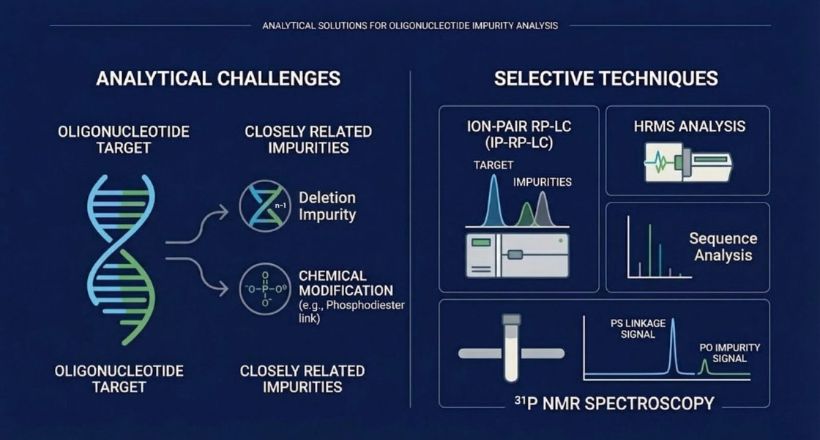
The rapid advancement of oligonucleotide therapeutics has introduced new analytical challenges for pharmaceutical scientists. These nucleic acid–based drugs, including antisense oligonucleotides and siRNA, often contain closely related impurity species that differ from the target molecule by only a single nucleotide or minor chemical modification.
Accurate identification and quantification of these impurities are essential to ensure product quality, safety, and regulatory compliance. However, traditional analytical approaches used for small-molecule drugs are often insufficient for these larger, highly charged biomolecules. As a result, specialized analytical techniques are required.
Chromatographic separation methods, combined with advanced detection technologies, play a central role in oligonucleotide impurity analysis.
Analytical Challenges in Oligonucleotide Impurity Profiling
Oligonucleotides present several unique analytical challenges:
- High structural similarity: Impurities such as n–1 or n–x truncations, deletion sequences, and mismatch variants differ from the target by only a single nucleotide, making separation difficult.
- Synthesis-related impurities: Solid-phase synthesis can introduce failure sequences, depurination products, and incomplete deprotection species.
- Chemical modifications: Therapeutic oligonucleotides often include modifications such as phosphorothioate linkages or 2′-O-methyl groups, increasing molecular heterogeneity.
- Charge and size effects: The high negative charge density and relatively large molecular size influence chromatographic behavior through counterion interactions and potential secondary structures.
Because of these complexities, high-resolution and highly selective analytical techniques are required for effective impurity profiling.
Ion-Pair Reversed-Phase Liquid Chromatography (IP-RP-LC)
Ion-pair reversed-phase liquid chromatography (IP-RP-LC) is one of the most widely used techniques for oligonucleotide analysis.
In this method, ion-pairing reagents interact with the negatively charged phosphate backbone of oligonucleotides, enabling their retention on hydrophobic stationary phases. Separation is driven by a combination of ion-pair interactions and apparent hydrophobicity differences.
Common ion-pairing systems include:
- Triethylammonium acetate (TEAA)
- Hexafluoroisopropanol (HFIP) with triethylamine (TEA), especially for LC–MS applications
IP-RP-LC is particularly effective for resolving truncated sequences and closely related impurities, making it a key tool in impurity profiling during drug development.
Ion-Exchange Chromatography
Ion-exchange chromatography separates oligonucleotides based on their charge interactions with the stationary phase.
Since oligonucleotides carry multiple negative charges along their backbone, this technique is well suited for separating sequence variants, truncated species, and impurities differing in charge density.
Separation is influenced by:
- Charge density
- Sequence length
- Base composition
Ion-exchange chromatography is often used as a complementary technique to reversed-phase methods. However, it may require desalting prior to mass spectrometry analysis, which can add complexity to workflows.
High-Resolution Mass Spectrometry (HRMS)
High-resolution mass spectrometry (HRMS), when coupled with liquid chromatography (LC–HRMS), is a powerful tool for oligonucleotide characterization.
This technique enables:
- Accurate molecular weight determination
- Identification of sequence variants
- Detection and localization of chemical modifications
Because oligonucleotides generate multiple charge states, data analysis requires charge-state deconvolution. High resolving power is particularly important for analyzing larger oligonucleotide molecules.
LC–HRMS plays a critical role in confirming impurity identities and supporting analytical method development.
Nuclear Magnetic Resonance (NMR) Spectroscopy
Nuclear Magnetic Resonance (NMR) spectroscopy is a valuable complementary technique for the structural characterization of oligonucleotides and their impurities.
Unlike mass spectrometric methods, NMR provides direct molecular-level structural information, making it particularly useful for confirming backbone chemistry and chemical modifications.
Detection of Phosphodiester (PO) Impurities
In phosphorothioate (PS)-modified oligonucleotides, phosphodiester (PO) impurities can arise due to incomplete sulfurization during synthesis. These impurities are critical to monitor because they can affect biological stability and overall drug performance.
³¹P NMR is especially well suited for detecting PO impurities because phosphorus atoms in different chemical environments produce distinct signals.
Using ³¹P NMR, analysts can:
- Differentiate PO and PS linkages based on their chemical shifts
- Quantify PO impurity levels through signal integration
- Observe PS stereochemistry (Rp/Sp diastereomers), which appear as characteristic split peaks
- Assess overall backbone composition without prior separation
Typically, PO linkages generate signals at chemical shifts distinct from PS linkages, enabling clear identification even in complex mixtures.
Beyond PO impurity detection, NMR can also be used to:
- Confirm phosphorothioate linkage integrity
- Identify sugar and base modifications
- Evaluate conformational and structural features
Importance of High-Purity Analytical Standards
Reliable impurity analysis depends on the availability of well-characterized analytical standards.
These standards are essential for:
- Confirming impurity identity
- Validating analytical methods
- Enabling accurate quantification
They are especially important when analyzing closely related oligonucleotide variants, where precise identification is critical. High-quality standards also support compliance with regulatory guidelines such as ICH Q2 and Q6B.
Advancing Analytical Solutions for Oligonucleotide Drugs
As nucleic acid therapeutics continue to evolve, the demand for advanced analytical techniques capable of resolving complex impurity profiles will grow.
Robust and orthogonal analytical approaches combining chromatography, mass spectrometry, and NMR are increasingly required to ensure comprehensive characterization and to meet stringent regulatory expectations.
At Daicel Chiral Technologies India, we support pharmaceutical research by providing expertise in advanced analytical solutions and high-quality analytical standards for oligonucleotide drugs.
Write a comment
Your email address will not be published. All fields are required