
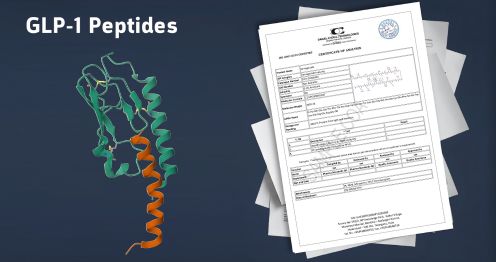
Purity is one of the most critical quality attributes (CQAs) for synthetic peptides. When reviewing an Abbreviated New Drug Application (ANDA), the FDA evaluates the types and levels of impurities present in a proposed generic drug compared to its Reference Listed Drug (RLD). This blog explores the characterization of GLP-1 peptide impurities, highlighting key strategies and methodologies.
Regulatory Considerations for Peptide Drug Impurities
The impurity control strategy for synthetic peptides is classified into the following key regulatory requirements:
- A generic synthetic peptide should not contain impurities at levels exceeding those found in the RLD.
- If a new impurity is detected in the generic peptide but absent in the RLD, its level should be controlled at no more than 0.5%. Additionally, a qualification study is required to assess potential immunogenicity risks. If no significant immunogenicity risk is observed, the impurity can be controlled at ≤0.5% by testing each batch.
- Any unknown impurity that is not present in the RLD must be controlled at ≤0.1% in every batch.
Robust analytical techniques, including UPLC, HPLC, and orthogonal methods such as UPLC-HRMS, are crucial for detecting and quantifying impurities in GLP-1 peptides. Certified impurity standards play a vital role in quantifying impurity levels, ensuring batch-to-batch consistency, and supporting analytical method validation.
Certification of Peptide Drug Impurities: Qualitative vs Quantitative aspects
- Qualitative Characterization identifies the structural composition of impurities. The qualitative characterization of GLP-1 peptide impurities involves HRMS and ¹H NMR. Since GLP-1 peptide impurities generally contain 30–40 amino acids, HRMS analysis is required to confirm their amino acid sequences and distinguish closely related variants. Amino acid composition analysis further establishes the number and types of amino acids present in the impurity, confirming its overall sequence characteristics. Elemental analysis, particularly nitrogen determination, provides additional insight into the total peptide content within the impurity sample.
- Quantitative Characterization determines impurity concentration, requiring potency evaluation along with structural confirmation. To determine peptide impurity potency, all impurity sources including organic, inorganic, counter ions and residual solvent content must be considered. The general potency calculation formula for peptide impurities is:
Potency (%) = 100 – [Total Organic Impurities + Inorganic Impurities + counter ions +LOD].
Key Analytical Parameters for Certifying Peptide Drug Impurities
| S. No. | Quantitative Characterization |
| 1 | Description |
| 2 | Solubility |
| 3 | Identification by Mass spectrometry (Monoisotopic mass) |
| 4 | Amino Acid Sequence by HRMS |
| 5 | Identification by 1H NMR |
| 6 | Identification by FT-IR |
| 7 | Amino Acid Composition |
| 8 | Peptide Content by Elemental analysis (N determination (%) |
| 9 | Purity by HPLC (% Area) |
| 10 | Acetate Content by HPLC as is basis (% w/w) |
| 11 | TFA Content by HPLC as is basis (% w/w) |
| 12 | Loss on drying (LOD) by TGA (%w/w) |
| 13 | Potency (%w/w) |
Write a comment
Your email address will not be published. All fields are required